ENQUIRY geetanjaliglobalgurukulam

Showing posts with label geetanjali lesson. Show all posts

Monday, October 13, 2025

Mahaganapathim Natta

 Composition: Composer: Muthuswami DikshitarMuthuswami Dikshitar (Mudduswamy Dikshitar)[1] (IASTmuttusvāmi dīkṣitar, 24 March 1776 – 21 October 1835),


By India Post, Government of India - [1] [2], GODL-India, https://commons.wikimedia.org/w/index.php?curid=75028085

Raga: Natta     JANYA OF        Mela: 36, Chalanatta
Tala: Adi                                  Type: Krithi

Arohana:   S R3,[G2] G3 M1 P {D3]N2 N3 S || S Ru, Gu Ma Pa Du Nu S
Avarohana: S N3 P M1 G3 M1 R3,[G2] S || S Nu  Pa Ma Gu Ma Ru, S

Arohanam:   S R3 G3 M1 P D3 N3 S

Avarohanam:   S N3 P M1 G3 M1 R3 S

Even though we say Jog is the hindustani equivalent of Nattai, unlike other Karnatik Hindustani equivalencies , both ragams have unique bhavam.

Nattai

The shatsruthi rishabam (or the 6 position of Rishabam) coincides with the second sruthi of Gandharam in the 22 sruthi space. This theevra rishabam gives the beauty to the ragam. The ragam gives a auspicious and a brisk mood to a concert even with the vivadhi nature of sruthis.

There are usually two versions of Nattai scale as we see from raga evolution. Nattai is a ubaya vakra sampoorna ragam as per Deekshitar paddathi. His krithis use D3 as well. We call that ragam as Chala Nattai in Govindacharya system now. Citing the other scale -

S R3 G3 M1 P N3 S and S N3 P M1 G3 M1 R3 S

Joghttps://raag-hindustani.com/Jog.html

The gandharam is the beauty of the ragam. The gandharam shows shades of the shatsruthi rishabam in Nattai but the way we handle the note in Jog is different. Gamakam is diminutive for gandharam in Jog.The ragam gives a more karunai oriented flavor. It evokes tranquility and bhakthi.

S G3 M1 P N3 S and S N2 P M1 G3 M1 G3 S G2 S

Hear a Nattai and a Jog and get the difference. Nattai is more madhyamakala and duritha kala ragam, while Jog shines in chowka kalam.

In Hindustani music, the Carnatic raga Nattai is most closely approximated by the raga Jog, though they are distinct ragas with unique characteristics. Nattai is known for its powerful, auspicious, and brisk mood and is characterized by the use of the shatshruti rishabha (a higher-pitched second note). Jog, while sharing similar notes, has its own unique emotional qualities and is often played at a slower tempo (chowka kalam) compared to the faster Nattai. 
Key Characteristics of Carnatic Nattai: 
  • Auspicious Mood: Nattai is often used to begin a concert and creates a joyful and auspicious atmosphere.
  • Melodic Structure: It is known for its emphasis on the Nattai rishabha (a high-pitched rishabha).
  • Scale: It contains all seven notes (sampoorna raga).
Key Characteristics of Hindustani Jog:
  • Emotional Quality: Jog has a distinct emotional flavor that differs from Nattai. 
  • Tempo: It is well-suited for slower tempos (chowka kalam). 
  • Notes and Structure: Jog's structure shares similarities with Nattai but treats the shatshruti rishabha differently. 
Why They Are Considered Equivalents (but not identical):
  • Mutual Counterparts: Nattai and Jog are considered mutual counterparts in their respective musical systems. 
  • Shared Notes: They share many of the same notes, making them similar in structure. 
  • Unique Character: The key difference is that while they share notes, the way these notes are handled and their specific "bhavam" (emotional essence) are unique to each raga. 

===Lyrics in English===mahA gaNa patim manasA - rAgaM nATa - tALaM - catuSra Ekam

pallavi

mahA gaNa patiM manasA smarAmi
(madhyama kAla sAhityam)
vasishTha vAma dEvAdi vandita

samashTi caraNam
mahA dEva sutaM guru guha nutaM
mAra kOTi prakASaM SAntaM
(madhyama kAla sAhityam)
mahA kAvya nATakAdi priyaM
mUshika vAhana mOdaka priyam

variations -
rAgaM - nATa - cala nATa
pallavi - vandita - vanditaM
https://youtu.be/0AgFsaU3WO4
===Lyrics in Devanagari===
महा गण पतिम् मनसा - रागं नाट - ताळं - चतुश्र एकम्

पल्लवि
महा गण पतिं मनसा स्मरामि
(मध्यम काल साहित्यम्)
वसिष्ठ वाम देवादि वन्दित

समष्टि चरणम्
महा देव सुतं गुरु गुह नुतं
मार कोटि प्रकाशं शान्तं
(मध्यम काल साहित्यम्)
महा काव्य नाटकादि प्रियं
मूषिक वाहन मोदक प्रियम्

variations -
रागं - नाट - चल नाट
पल्लवि - वन्दित - वन्दितं
===Meaning===
Pallavi :
I think of Mahaganapati in my mind, the one worshipped by the sages like Vashishta and Vamadeva.

Samashti Charanam :
The son of Mahadeva; the one praised by guruguha,the one who shines forth like crores of manmathas, the placid one, the one who is fond of great literary works and plays, the one who has a rat for a vehicle, and one who is fond of modakas

kshEtra - tiruvArUr
Word by word meaning
Maha - Great
Ganapati - The Lord of the Ganas
manasA - in my mind
smarAmi - think of
Vasishta, VamadevAdi - (By) sages like Vasishta and Vamadeva
vandita - venerated
mahAdeva - Shiva
sutam - son
guruguha - the signature of the composer / By subrahmanya
nutam - praised by
mArakOti prakAsam - resplendent like crores of manmathas
SAntam - placid/calm

Thursday, June 20, 2024

Mayamalavagaula makes sense,Shankarabharanam incents

  Mayamalavagaula makes sense, it is a major janaka raga and the notes are spaced equally in the purvangam and the uttarangam. 

Primarily 4 reasons why MMG was chosen.

1. 

The spacing between the notes of the first half ( S R G M ) and the second half ( P D N S ) is the same. This means that effectively both halves are mirrors of each other.

2. 

3. 

The natual oscillatory gamaka present in Carnatic makes it difficult to render ragas like Shankarabharanam or Kalyani for a beginner. MMG lets you skip the oscillation entirely and just sing straight notes. This does not detract from the overall feel of the ragam as it would when singing Shankarabharanam ( it will sound like its being played on a keyboard minus the gamakas )

4. 

5. 

When Abhyasa Gaanam ( Music for practice and beginners ) was written in the 15th century, MMG was one of the most happening ragas along with several of its children ( Lalita, Padi, Bhouli, Gouri, Gowla, Saveri ). So it was chosen as the default.

6. 

7. 

If you start with Shankarabharanam, then the intervals between the swaras all sound the same, so when you transition to say HariKambhoji ( Just a N flip ) its almost impossible to learn it properly.

8. 

all 3 types of swara spacings are found in MMG (apart from Vivadi raga type spacings). Between S and R - 1 space, between R and G - 3 spaces, between G and M - 2 spaces. Similarly in uttaraangam

 if you use R2 and D2, then all intervals are same, making it more difficult to learn other ragas. Nearly every interval is different in Mayamalavagowla, which means more initial difficulty in the beginning, but far easier learning later.

One theory is that Mayamalavagowla is taught first because of the way it is performed on the veena. The first few frets are quite large, and it isn't as convenient to move from sa to ri and pa to da on shankarabharanam (for beginners), because there is another note in between.

But while playing Mayamalavagowla, the frets are next to each other, and so are easier to play for beginners. Once the players get used to this, then they move to ragas like shankarabharanam.


Main reasons is that MMG's gamakams are symmetric in terms of movement... For eg... The movement from S to R is the same as P to D and the movement from G to M is same as D to N.... And if you see gamakams wise... The 4th note in SRGM and PDNS is still so it makes it a very gamaka symmetric raga...

That being said, it's easier to understand gamakams at very beginner stage in MMG than any other raga, and gamakams is the core of Carnatic Music..

Thats why no one teaches you sankarabharanam at this stage coz it is already an evolved rAgam on its own with complex gamakams and phrases... 'Sankarabharanam' heard in western music is called Major scale and is no where close to the raga Sankarabharanam..

Two main reasons can be thought of from the perspective of voice and Veena.

1. 

The ragam has notes that are not confusing (meaning there is no scenario where the r can be a g in a different ragam and vice versa), hence it is easy to explain to the learner that r1 is r and g3 is g.

2. 

3. 

The difference in pitch/frequency between n-s-r, g-m and p-d are such that it trains the mind to distinguish notes that are closest to each other.

4. 

starting in Mayamalavagaula for all the reasons listed. Beginners get familiar with semitones.About gamaka in the beginning. Please avoid kampita and jaru in playing varisai. Being able to hold steady notes in perfect alignment with the shruti and steady tala are what's aimed for, along with good voice and instrument technique. Janta varisais are the basis of all gamaka and need to be taught well with proper technique.

It really helps singers to learn an instrument to understand the details - not harmonium. Veena is perfect. Flute or violin are good, but very challenging initially, whereas veena is initiallyquite straightforward.

Once the student starts gitams, the gamakas comes in progressively. Learning gitams in 30 or 40 ragas will lead to internalising a great raga database with the key sancharas at your fingertips. Sankarabharanam is a very complex raga and is not the carnatic equivalent of the western major scale. The gamakas give it a completely different feel. 


Thursday, March 21, 2024

Sri Nathadi Guruguho Jayathi Muddusvami Dikshita

Abstracted from: Compositions of Muddusvami Dikshitar by Sangeetha Kalanidhi T. K. Govinda Rao, published in Chennai 1997 (No. 43). English edited by me. This is Guruguha Vibhakti kriti No. 1.

Raga: mAyAmALavagauLa / Tala: Adi

P: shrInAthAdi guruguhO jayati jayati shrI cidAnanda nAthOhamiti santatam hRdini bhaja

A: nAnAprapaHnca vicitrakarO namarUpa paHnca bhUtAkarO ajHnAna dhvAnta pracaHNDa bhAskarO jHnAnapradAyakO mahEshvarO dInAvanOdyukta divyatarO divyaughAdi sakaladEha dharO mAnasAnandakara caturatarO mad guruvarO maHNgaLam karOtu

C: mAyAmaya vishvAdhiSThAnO mAtmaka kAdi matAnuSThAnO mAlinI maNDalAnta vidhAnO mantrAdyajapA hamsa dhyAnO mAyAkArya kalanA hInO mAmaka sahasra kamalAsInO mAdhurya gAnAmRta pAnO mAdhavAdyabhayavarapradAnO mAyAshabaLita brahma rUpO mArakOTi sundara svarUpO matimatAm hRdayagOpuradIpO mattashUrAdi jayapratApO mAyAmALavagauLAdidEshamahIpati pUjita pada pradEsha mAdhavAdyamara bRnda prakAsha mahEshasya mahArthOpadEsha

English

Victory to Lord Guruguha, who is adored by all Gods beginning with Vishnu. Oh Mind, constantly contemplate on the fact that you are the Cidanandanatha.

He is the originator of different diversified forms of worlds. He manifests as five elements, the named and formed ones. He is the mighty sun, destroying the darkness of ignorance, is the bestower of spiritual knowledge, and is the Maheshvara. He is the divine Kalpaka Vriksha for the afflicted ones, he who bears the sacred river like Mandakini, he who is adept at granting happiness to the heart of His devotees. May my Guru bless me.

He is the substratum of this illusory world. He who is to be invoked through the mantra beginning with Ka and ending with Ma, he who resides in the center of the Malini Chakra, he who is meditated upon as the swan representing the Ajapa Mantra, he who is an expert at obliterating the result of Maya the illusion, he resides in my heart, which is like the thousand-petalled lotus. He who enjoys the nectar of mellifluous music, he provides shelter and boons to Madhava and others. He whose Brahmasvarupa is veiled by Maya, he whose beauty exceeds that of crores of Cupids, he who shines as the light atop the tower of the heart of devotees, he who vanquished the proud Shura and others, his place of abode is worshiped by kings of Mayamalava Gaula Desha et al. He who shines as surrounded by Vishnu and other gods, he has expounded the real truth of Pranava to His father Mahesha.


Pallavi:Sri Nathadi Guruguho Jayathi Jayathi Sri Chidaananda Naathohamiti Santhatham Hridini Bhaja


Anupallavi:Naanaa Prapancha VichitrakaroNaamaroopa Pancha Bhoothakaro


Ajnaana Dhvaanta Prachanda BhaaskaroJnaana Pradaayako Maheshwaro


Madhyama Kala Sahityam:


Dinavanodyukta Divyataro


Divyaughaadi Sakala Deha Dharo


Maanasaanandakara Chaturataro


Mad Guruvaro Mangalam Karotu


Charanam:


Maaya Maya Visvaadhisthaano


Maatmakaadi Mataanusthaano


Maalini Mandalaanta Vidhaano


Mantraadyjapaa Hamsa Dhyaano


Maayaakaarya Kalanaa Heeno


Maamaka Sahasra Kamalaasino


Maadhurya Gaanaamruta Paano


Maadhavaadyabhaya Vara Pradaano


Maayaa Sabalitha Brahma rupo


Maarakoti Sundara Svarupo


Mathimataam Hrudaya Gopura Dipo


Matta Suraadi Jayaprataapo


Madhyama Kala Sahityam:MaayaamaalavagaulaadideshaMahipati Pujitha Pada PradeshaMaadhavaadyamara Brunda PrakaashaMaheshasya Mahaarthopadesha


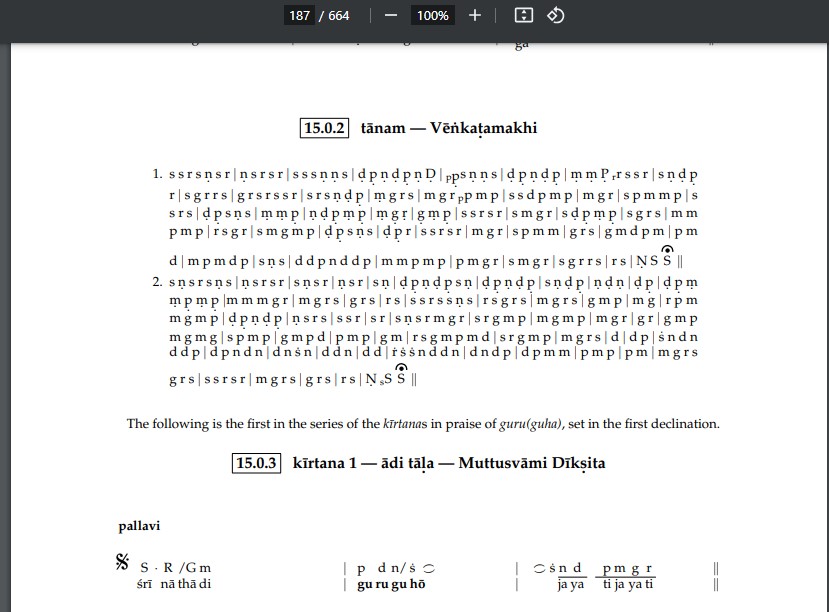
  15.0.3 k¯ırtana 1 — ¯adi t¯al . a — Muttusv¯ami D¯ıks. ita


 pallavi S · R /G m p d n/ s˙_^ s n d p m g r 

sr´ ¯ı na th ¯ a di ¯ | |  _^ gu ru gu h ¯o | | ˙ ja ya ti ja ya ti 

S ∵ s /N N · d ∵ D _^^ d P ∵ p m ∴ m G∵ g R ∵ r s ∵ s n. ∵ n

 sr´ ¯ı ci da na ¯ m da n ˙ a¯ | | _ tho ha mi ti sa ¯ m˙ | | . ta tam h ˙ r di ni bha ja ˙

 S · N. ∼∼∼ D. p .d. n. s/ ∼∼∼ r __^ r s w n. / S 

 sr´ ¯ı na th ¯ a di ¯ | | ^ gu ru gu ho¯ | | ja ya ti 

Tuesday, September 5, 2023

LEARNING TO TEACH@5G SERIES1-RAGA-SHANMUKHAPRIYA-PART1

LEARNING TO TEACH@5G SERIES1-RAGA SHANMUKHAPRIYA-PART1

https://youtu.be/XVMK_6VSSV0 

LEARNING TO TEACH@5G SERIES1-RAGA-SHANMUKHAPRIYA-PART2

identify by popular tunes

https://www.youtube.com/watch?v=VzuBqDVTo1w


Apart from the much broader divisioning of the ragas into Melakarthas and Janya ragas, that is.

There are 72 Melekartha ragas (previously mentioned), each of which fall into one of the 12 ‘Chakras’. Thus, there are 72 / 12, or 6, ragas in each Chakra. Just like in the katapayadi sankhya where Vedic mathematics was used, here too, one can find a similar convention adopted to give names to these 12 Chakras.

  • The 10 directions,N,E,W,S,NE,NW,SE,SW, including akash (sky) and patal (nether region), is represented by the tenth chakraDisi.

  • LEARNING TO TEACH@5G SERIES1-RAGA-SHANMUKHAPRIYA-PART1https://www.youtube.com/watch?v=wlXHFXqjSAY
  • This section covers the theoretical and scientific aspect of this rāgam.

    Shanmukhapriya's notes when shifted using Graha bhedam, yields 3 other major melakarta rāgams, namely, ShooliniDhenuka and ChitrambariGraha bhedam is the step taken in keeping the relative note frequencies same, while shifting the shadjam to the next note in the rāgam. For further details and an illustration refer Graha bhedam on Shanmukhapriya.

    Shanmukhapriya corresponds to Hungarian Gypsy scale in Western music.

    Notes[edit]

    1. ^ Alternate notations:
      • Hindustani: S R   P   
      • Western: C D E F G A B C
    2. ^ Alternate notations:
      • Hindustani:    P   R S
      • Western: C B A G F E D C


      • Shanmukhapriya
        ArohanamS R₂ G₂ M₂ P D₁ N₂ 
        Avarohanam N₂ D₁ P M₂ G₂ R₂ S


  • 56ShanmukhapriyaS R2 G2 M2 P D1 N2 S
    Arohana: Sa, Ri2, Ga2, Ma2, Pa, Dha1, Ni2, Sa*

    Avarohana: Sa*, Ni2, Dha1, Pa, Ma2,Ga2, Ri2, Sa

    (Chatusruti rishaba, Sadharana gandhara, Prati madhyama,Suddha daivatha and Kaishiki nishada.)


    A composition later set to Shanmukapriya


    திருப்புகழ் 6 முத்தைத்தரு (திருவருணை)
    தத்தத்தன தத்தத் தனதனதத்தத்தன தத்தத் தனதனதத்தத்தன தத்தத் தனதன ……தனதான.. .


  • S, S, SS     S, S, SS SR
  • R, G, RS    S, S, SS Sn
  • n, S, nd     d, n, dd pm
  • pd , n , , S , , , , , , ,
  • Muthai tharu pathi thirunagai thirupuzhal _ Arunagirinathar Notes Used: s r2 g1 m1 p d1 n2 S ( g2 , d2 are used in some places ) Ragam: Shanmughapriya Thalam: Misra chapu Aroganam : sa ri2 ga1 ma2 pa di1 ni1 sa Avarohanam: sa ni1 da1 pa ma2 ga1 ri1 sa 

  •  [ முத்தைத்தரு பத்தித் திருநகை அத்திக்கிறை சத்திச் சரவண முத்திக்கொரு வித்துக் குருபர …… எனவோதும் 
  • ni saa sa sa saa saa sa sa sa ri ri gaa ri sa saa saa sa sa sa sa ni saa sa ni daa ni da ni da pa..........pa daa ni nii saa] 

  •  [ முக்கட்பர மற்குச் சுருதியின் முற்பட்டது கற்பித் திருவரும் முப்பத்துமு வர்க்கத் தமரரும் …… அடிபேணப் 
  • ri gaa ga ga gaa ga ga ma pa ma rii rii ri ri rii rii sa ga ri sa nii nii ni ni saa saa ni sa ni da.....pa daa ni nii saa / nii ] 

  •  [பத்துத்தலை தத்தக் கணைதொடு ஒற்றைக்கிரி மத்தைப் பொருதொரு பட்டப்பகல் வட்டத் திகிரியில் இரவாகப் 

  • paa daa ni sa saa saa sa sa sa ni paa daa ni sa nii nii ni ni ni da paa nii da pa maa paa pa ma ga ri - sa ri sa ri ga ma paa]] 

  •  [ பத்தற்கிர தத்தைக் கடவிய பச்சைப்புயல் மெச்சத் தகுபொருள் பட்சத்தொடு ரட்சித் தருள்வதும் …… ஒருநாளே 
  • paa daa ni sa saa saa sa sa sa ni paa daa ni sa nii nii ni ni ni da paa nii da pa maa paa pa ma ga ri - pa daa ni nii saa] 

  •  [ தித்தித்தெய ஒத்தப் பரிபுர நிர்த்தப்பதம் வைத்துப் பயிரவி திக்கொட்கந டிக்கக் கழுகொடு …… கழுதாடத் 
  • paa daa ni sa saa saa sa sa sa ni paa daa ni sa nii nii ni ni ni da paa nii da pa maa paa pa ma ga ri - sa ri sa ri ga ma paa ] 

  •  [ திக்குப்பரி அட்டப் பயிரவர் தொக்குத்தொகு தொக்குத் தொகுதொகு சித்ரப்பவு ரிக்குத் த்ரிகடக …… எனவோதக்
  •  paa daa ni sa saa saa sa sa sa ni paa daa ni sa nii nii ni ni ni da paa nii da pa maa paa pa ma ga ri - pa daa ni nii saa ]
  •  [ கொத்துப்பறை கொட்டக் களமிசை குக்குக்குகு குக்குக் குகுகுகு குத்திப்புதை புக்குப் பிடியென …… முதுகூகை

  •  paa paa pa sa saa sa sa sa sa sa paa paa pa ri rii rii ri ri ri ri paa paa pa ga gaa gaa ri ga ri sa ..... pa da ni sa ri ga rii ]
  •  [ கொட்புற்றெழ நட்பற் றவுணரை வெட்டிப்பலி யிட்டுக் குலகிரி குத்துப்பட ஒத்துப் பொரவல …… பெருமாளே.

  •  gaa gaa ga ga gaa gaa ga ma pa ma rii rii ri ri rii rii sa ga ri sa nii nii ni ni saa sa ni sa ni da - pa da ni sa ri ga saa ]